
Theoria Weekly #1
Trips.com, CXMT, Tencent, Boss Zhipin and Fields Metal

I’ve been thinking about starting a shorter, more frequent format for a while, and this week I finally decided to give it a try.
The plan is to send out a short letter on Sunday evening (ET) whenever I have not published a long write-up that week, covering some of the topics that have recently drawn attention, both within China’s investment community and in society more broadly, along with the latest developments at the companies I follow and, of course, my thoughts on them.
These letters will inevitably be biased toward my own interests and limited by the information I have access to, but I hope readers will still find them helpful in their own investing in China.
Anti-trust investigation on Trips.com
We finally received an update on the antitrust investigation into Trip.com, which was formally launched in January over the company’s suspected abuse of its dominant market position. The regulator concluded that, since 2020, Trip.com had used traffic allocation, platform rules and pricing tools to pressure hotels into exclusive arrangements and require them to offer the lowest prices on its platform, restricting their ability to work with competitors and set prices independently.
Trip.com was fined RMB 3.52 billion, or 7.5% of its 2025 domestic revenue, while another RMB 1.66 billion of illegal gains was confiscated. Together with RMB 122 million of deposits that it must return to hotel operators, the total financial impact is approximately RMB 5.30 billion. This is a fairly heavy penalty—roughly twice the amount I estimated in my previous post based on past case of Alibaba and Meituan.
Trip.com posted a PR right after the announcement, accepting the ruling and announced 19 corrective measures. Most importantly, it will end its “special” exclusive-distribution model, remove the “lowest price across the internet” requirement, discontinue the related merchant-ranking and traffic arrangements, and shut down tools that allowed the platform or its staff to adjust hotel prices without explicit approval. It also promised to introduce a more transparent commission and traffic-allocation system, stop forcing hotels to participate in promotions and strengthen its antitrust and consumer-protection controls.
As I argued in my previous post, the size of the fine is not particularly important. It is ultimately a one-time cost and should not materially affect Trip.com’s long-term value. More importantly, the worst-case outcome did not happen: the government did not force Trip.com to break up or fundamentally restructure its business in any way. That is clearly good news for shareholders.
The more difficult question is how the 19 corrective measures will affect Trip.com’s moat. Some of the practices targeted by the regulator—such as exclusive arrangements, lowest-price requirements and the use of traffic allocation to influence hotels—were unfortunately signatures of the platform’s competitive advantages. Perhaps more importantly, before assessing their impact, investors first need to understand how seriously Trip.com will implement these measures and how strictly the government will enforce them going forward.
These questions may not be easy to answer, and it could take time to get some clarity. Given this uncertainty, investors looking to gain exposure to China’s travel sector may find a simpler opportunity elsewhere, such as in the hotel chains I have written about before.
CXMT will list on Shanghai’s STAR Market on July 27. Its RMB 57.9 billion offering is the largest IPO in the board’s history.
The allotment results were announced this week: around 7.7 million winning numbers were issued, with each winner entitled to purchase 500 shares. The final online winning rate was about 0.47%, reportedly far higher than that of a typical STAR Market IPO. Combined with the relatively modest cash requirement of RMB 4,330 per winning lot, thanks for an IPO price of RMB 8.66/share, the offering has been extremely popular among retail investors. Indeed, almost every investor I know who was eligible to participate applied for the shares.
As China’s leading DRAM producer and the world’s fourth-largest supplier, CXMT is one of the country’s most strategically important semiconductor companies. Unsurprisingly, there is no lack of institutional participation in the IPO.
A total of 113 private fund managers secured allocations worth more than RMB 13 billion. Funds associated with Liang Wenfeng’s High-Flyer (founder and backer of DeepSeek) were among the largest participants, receiving around RMB 175 million in total. Another 36 insurance institutions were allocated approximately RMB 6.1 billion, or more than 10% of the offering. This includes long-term investors such as the National Social Security Fund and several state-backed funds.
Tencent gave back almost all its gains from the previous three weeks, falling about 6% last week. There were few attempts to explain the sell off:
Firstly, Investors concerned about Tencent’s Q2 gaming performance. A Bernstein report cited Sensor Tower data showing that Tencent’s domestic mobile game receipts fell 2.6% year over year in the second quarter, with its top three games down 13%.
However, Sensor Tower date cover only iOS revenue in China, excluding Android, PC and oversea contributions, so their significance is limited. More importantly, quarterly fluctuations are perfectly normal in gaming and tell us little about the long-term health of the business.
Secondly, Chinese mutual fund holdings for Q2 was released last week. Tencent was the most heavily sold stock, with active equity funds reducing their holdings by roughly RMB 20 billion. Much of that capital have been redirected toward AI stocks, as mutual fund exposure to the electronics and communications sectors increased by more than 20% QoQ.
If this is really the reason behind Tencent’s sell off, Chinese markets are really a paradise for value investors. We all know the institutional imperative: facing redemption pressure and short-term performance comparisons, fund managers are structurally unable to be contrarians. It reminds me of the situation at Fundsmith.
Tencent certainly looks cheap on a static valuation basis, but I believe the key to Tencent’s investment today is to understand how AI will affect Tencent’s moat and earning power—a much more complicated topic that deserves a separate discussion.
Boss Zhipin’s World Cup ad campaign
The World Cup wrapped up last week. As readers of my deep dive may remember, BOSS Zhipin’s aggressive advertising campaign during the 2018 World Cup was a inflection point for the company. The campaign sharply increased its visibility, and user growth accelerated thereafter.
Its approach to advertising reminds me of Duan Yongping. Much of BBK’s early success was supported by expensive, high-profile campaigns, including prime advertising slots during the Spring Festival Gala and celebrity endorsements from Jackie Chan.
And both Zhao and Duan shared a similar logic: the absolute spending may look enormous, but when an advertisement reaches hundreds of millions of people through a national or global event, the cost per viewer can actually be extremely low, and consequently the ROI is very attractive.
BOSS Zhipin continued to advertise heavily during this year’s World Cup, but the message was noticeably different. Rather than repeatedly explaining what the platform does or urging people to find a job, its ads featuring Shen Teng, one of China’s most popular comedic actors, encouraged viewers to slow down, take a break and enjoy the match. I thought it was a creative way to keep the brand visible without selling too hard:
Two Chinese mathematicians won the Fields Metal
This week, Hong Wang, a professor at NYU and IHES, and Yu Deng, a professor at the University of Chicago, became two of the four winners of the 2026 Fields Medal. For those unfamiliar with the award, it is often described as the Nobel Prize of mathematics and is presented every four years to outstanding mathematicians under the age of 40.
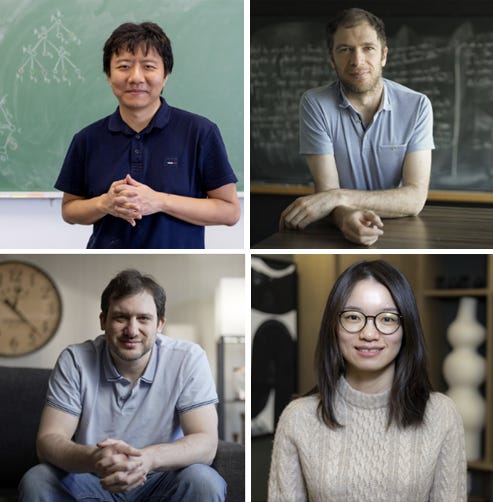
Wang and Deng are the first Chinese nationals to receive the medal—and China got two winners at once. Wang is also the third woman to win the award in its 90-year history. Unsurprisingly, the news was a big deal for the Chinese public and quickly became a trending topic.
For anyone interested in their personal journeys and the mathematical problems they solved, I highly recommend Quanta Magazine’s profiles of Yu Deng and Hong Wang.
As a former researcher, I found their stories particularly relatable: the self-doubt, the ambition to solve important problems, and the pressure to publish in top-tier journals. Despite their talent, both followed uncertain and indirect paths.
Yu Deng, for example, failed to qualify for a national Go tournament in middle school, which led him to turn his attention to mathematics. After completing his postdoc at NYU, he received no tenure-track offers from his preferred institutions and came close to taking a finance job in China.
Hong Wang did not secure the single place available in Peking University’s mathematics program, so she initially enrolled in earth sciences before later switching to mathematics. While studying in France, she doubted whether she was good enough to pursue mathematical research. At one point, she switched to architecture and spent a semester interning at a firm in Paris.
What kept them going through these setbacks? The first was a pure love of mathematics. Both had enjoyed solving mathematical problems from a young age, and whenever they faced uncertainty or disappointment, they could return to the work itself and focus on the next problem.
The second was the support they received throughout their lives—from parents who encouraged their interests without placing too much pressure on them, to mentors and collaborators who gave them the patience, confidence and support to continue through difficult periods.
Their journeys show that talent matters, but so does an environment that gives people the freedom and support to pursue their passion and allows it to flourish.
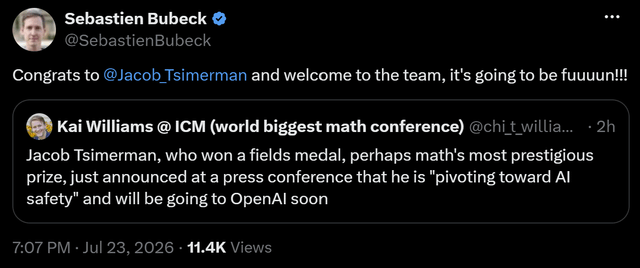
Oh, and before I wrap it up: the other winner Jacob Tsimerman, a professor at UofT, announced he is joining OpenAI:)
That’s all for now. See you next time.