
Theoria Weekly #2
Deepseek, Laopu Gold, Pop Mart, Moutai and PDD

DeepSeek putting its 2nd fundraising round on hold
It was reported that DeepSeek has told prospective investors that it is putting its second fundraising round on hold for now. The news came just days after a four-hour recording of Liang Wenfeng speaking with investors was leaked and went viral. The transcript has since been removed from the Chinese internet.
I picked out ten points from the transcript that you might find most interesting:
Liang does not see DeepSeek as a company whose goal is to maximize profits. He wants it to do something useful for humanity and believes the company should operate with genuine goodwill toward the world.
DeepSeek is not managed through KPIs or layers of performance reviews. What holds the team together is a shared vision. Liang admires former GE CEO Jack Welch and believes that large organizations are ultimately driven by vision, not rules.
At DeepSeek, top-down assignments are not supposed to take up more than half of an employee’s time. The rest is deliberately left open for researchers to explore ideas and pursue projects of their own choosing. (remind me of Google)
Liang believes DeepSeek’s most important task is to keep its core team together. As long as the key people stay, he believes the company can keep moving forward and eventually achieve AGI.
From a business perspective, Liang believes open-sourcing AI can actually be beneficial. He does not see open source and commercial monetization as being in conflict.
DeepSeek has only one real priority: AGI. Consumer traffic, enterprise revenue, multimodal products etc., are secondary.
Liang believes the next major breakthrough after agents will be continual learning. After that, models will begin to improve themselves continuously, eventually leading toward embodied AI.
In his view, the only meaningful gap between China and the US is not talent, but resources, especially compute. DeepSeek’s current approach is simple: buy as many chips as it can at reasonable prices.
Domestic AI chips have a historic opportunity because AI is rapidly weakening the moat created by Nvidia’s CUDA ecosystem.
Liang believes Chinese AI chips are already competitive in both hardware and software ecosystems. The main constraint is production capacity, and he does not expect China to still be stuck on this problem five years from now.
DeepSeek was highly selective about who it allowed into the 1st round, focusing on investors whose long-term interests were aligned with the company’s. Only a small group of institutions were invited to participate, and the investment came with a number of restrictions.
According to reports, Liang Wenfeng was the largest investor, committing around RMB 20 billion of his own money. Tencent invested about RMB 10 billion, CATL-related entities around RMB 5 billion, while NetEase, JD.com, Monolith Capital and IDG Capital each contributed roughly RMB 3 billion. China’s national AI industry investment fund invested another RMB 980 million.
Laopu Gold’s positive profit alert turned out to be not so positive
On July 27, Laopu Gold (6181.HK) issued a positive profit alert, forecasting first-half 2026 revenue of RMB19.8–20.4 billion, up 60%–66% yoy, and adjusted net profit of RMB4.31–4.36 billion, up 83%–85%. The numbers looked spectacular at first glance. Yet the shares plunged nearly 24% the following day.
The reason becomes clearer when we compare the guidance with the preliminary Q1 figures released in March. Laopu had expected Q1 revenue of RMB16.5–17.5 billion and net profit of RMB3.6–3.8 billion. Taken together, the two announcements imply Q2 revenue of only RMB2.3–3.95 billion, down 76%–87% from the first quarter. Q2 profit is estimated at roughly RMB0.5–0.8 billion, down more than 80% QoQ and around 34%–56% YoY.
For those unfamiliar with Laopu Gold, it is a Chinese luxury jewellery brand specializing in “heritage gold”—gold pieces made using traditional Chinese craftsmanship and designs inspired by classical Chinese culture.
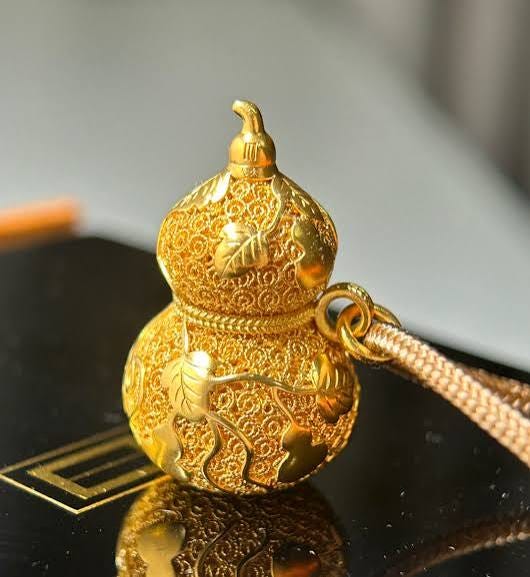
It emerged as one of China’s hottest homegrown luxury brands, with products ranging from several thousand to several hundred thousand yuan. Together with Pop Mart (9992.HK), Mixue (2097.HK) and Mao Geping (1318.HK), it was once called Hong Kong’s “New Consumption F4.” All four stocks have now fallen by more than half from their peaks.
I do think the sell-off of the F4 may have created some value opportunities. But Laopu Gold is probably not one of them.
The problem is quite obvious if we look at its cash flow:
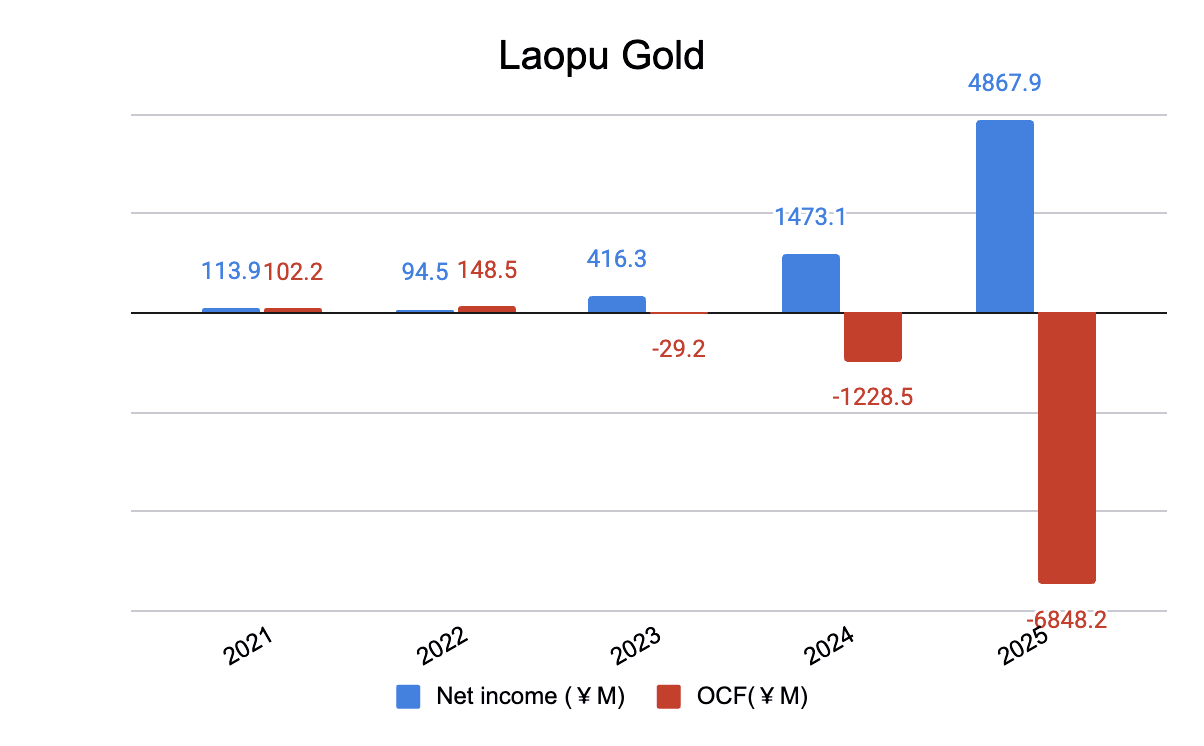
Net income has surged, yet operating cash flow has become increasingly negative. A closer look shows why: nearly all the cash generated by the business is being absorbed by inventory. Part of the increase is due to much higher Gold price, so replenishing the same amount of inventory now costs more. But part of it is also a deliberate growth bet: management is expanding rapidly and building inventory ahead of the stronger sales it expects in the future.
If nearly all of Laopu’s internally generated cash is tied up in inventory, how is it funding the rest of its expansion? The answer is debt and dilution:
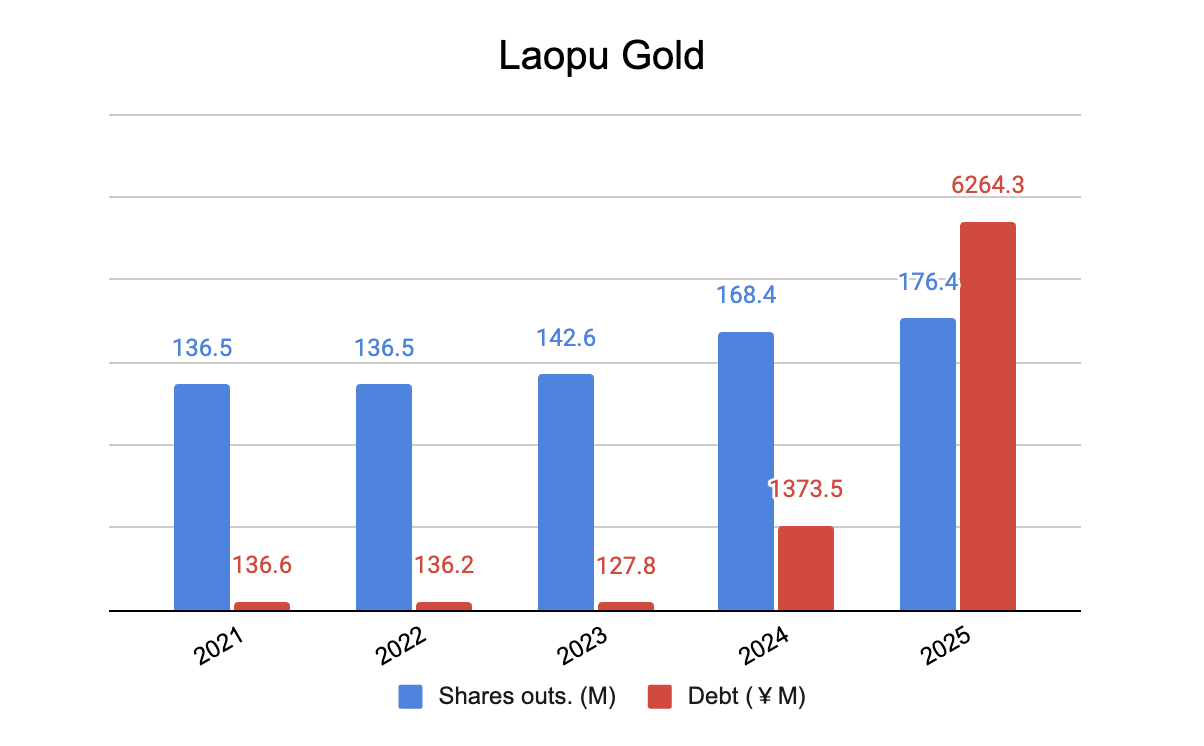
Many investors would point to Laopu’s brand value, luxury positioning and distinctive heritage-gold craftsmanship. But I would say it’s hard to separate Laopu’s lately extraordinary growth from the surge in gold prices and the resulting enthusiasm for gold. If the reverse of gold prices is permanent, the company could face a double hit: weaker demand leads to excess inventory, while falling gold prices could also force it to write down part of that inventory. Seen this way, Laopu Gold starts to look less like a luxury brand and more like a leveraged gold ETF.
Inside Pop Mart’s New Toronto Store
After Laopu Gold, let’s turn to another member of the “new consumer F4”: Pop Mart. The company finally opened a store in Toronto’s Eaton Centre, so I stopped by last weekend. For now, it is only a pop-up. An employee told me that it will eventually move into a much larger—and presumably better-located—space in the mall.
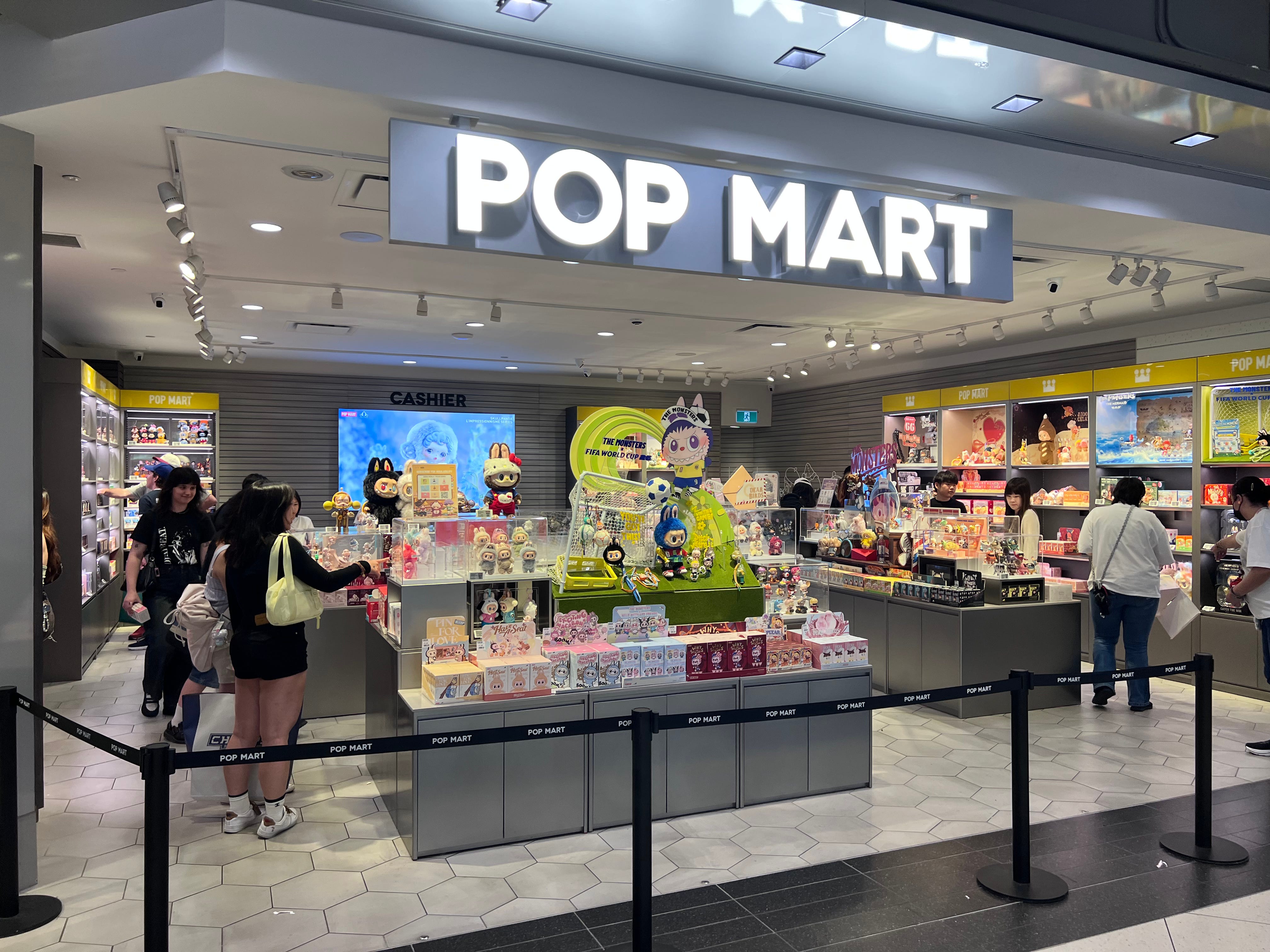
The traffic is pretty good and I saw several customers practicing what collectors call “box shaking”: gently shaking and weighing blind boxes to guess which figure is inside before buying.
I also spoke with two employees, both of whom were Pop Mart fans themselves—one preferred Labubu, while the other was a Hirono fan. You could tell that they genuinely loved the characters and the broad collecting culture. One of them told me that Pop Mart sells art, not toys — an idea repeatedly emphasized by the founder & CEO. Either Pop Mart trains its staff incredibly well, or designer toys really are becoming a new culture and trend—not just the fad many people think they are.
I’m probably a little too old to fully get the new culture:) But even I could see that Pop Mart’s figures were in a different league from the other character toys sold elsewhere in the same mall. The materials, detailing and overall finish were noticeably better.
The displays, layout and lighting in Pop Mart’s store is also another level. Other stores like Miniso are just retailers crowded with merchandise, while Pop Mart felt more like a small art exhibition, with each IP carefully displayed and the whole space designed around the experience.
On July 17, Kweichow Moutai announced its second price increase of the year for a 500ml bottle of 53-degree Flying Fairy Moutai. The retail price on the iMoutai platform rose from RMB 1,539 to RMB 1,639, while the ex-factory price—the price paid by contracted distributors—increased from RMB 1,269 to RMB 1,369. A few days later, reports emerged that Moutai’s offline self-operated stores had raised their price further to RMB 1,719.
This follows the price increase in March, when Moutai raised its self-operated retail price from RMB 1,499 to RMB 1,539, finally ending the eight-year “RMB 1,499 era.”
On the one hand, the price increases are part of a broader effort by Moutai to regain control over pricing and push distributors to earn their margins through actual service rather than scarcity alone.
On the other hand, raising prices twice during the traditionally weak season—and in the middle of a broader downturn across the baijiu industry—also shows the strength and scarcity of the brand. Bottles on iMoutai remain extremely difficult to secure even after the price increases.
The common investor view of Chinese baijiu companies is that they have excellent business models but often mediocre management and governance, partly because many of the industry leaders are state-owned. In my view, Moutai is the exception: it combines an extraordinarily rare business model with a strong corporate culture built around always trying to do the right thing.
Small Merchants Force Xufuji’s Pinduoduo Store to Shut Down
The official flagship store of Xufuji, a Chinese snack-food giant with nearly RMB 10 billion in annual revenue, recently came under a coordinated attack by small merchants on PDD. They placed a large number of orders and then applied for “refund without return,” overwhelming the store’s customer-service and delivery systems. The operator had to intercept parcels already in transit, cancel unshipped orders and eventually shut the store. On July 27, Xufuji clarified that the store was run by an authorized distributor, not by PDD itself.
The merchants’ anger has been building for years. PDD’s “refund without return” policy has caused real losses for many sellers, as some customers claim refunds on perfectly good products without sending them back. Merchants also worry that PDD may increasingly direct traffic toward its own retail operations.
A similar episode happened in 2023. Merchants first targeted PDD’s newly launched self-operated store, then moved on to stores linked to brands such as Xufuji and Nestlé. This time, they even dug up a list of Tmall stores operated by companies connected to Leqee, an e-commerce service business founded by Colin Huang, and used it to identify suspected PDD-operated stores. Many of the stores they targeted, however, were actually run by independent distributors.
“Refund without return” means buyers can receive a refund without sending the product back. In one recent case, a buyer ordered 1,100 pieces of clothing and obtained refunds on 1,000 of them, leaving the merchant with a reported loss of RMB 52,000. Sellers also complain that they have little room to appeal, turning what began as a consumer-protection policy into an easy way to game the system.
The policy has since been rolled back across the industry. In 2025, PDD, Taobao, JD.com, Douyin and Kuaishou all changed their rules so that post-delivery requests would generally be handled by merchants rather than automatically approved by the platform. A new regulation effective from February 2026 also prohibited platforms from forcing merchants to provide refunds without returns.
I believe PDD’s original intention was good: “refund without return” was meant to push merchants to take product quality more seriously, especially given the platform’s long-standing reputation for cheap but low-quality goods. However , the policy became an easy loophole for fraudulent refund claims. This may be an inherent dilemma for a platform focused on low-priced products: disputes between buyers and sellers are more likely, but given the low average order value, it often makes little economic sense for the platform to investigate and mediate every case.
That’s all for now. See you next time.
Wowwwwwww the Laopu Gold thing. Wow. I know the HKEX is a hive of scum and villainy but they've gotta be head, torso and waist over the edge of "omit material facts of an unfavourable nature or fail to accord them with appropriate significance" with how they wrote that release.
Re DeepSeek - given the context that DeepSeek was basically bootstrapped, and the 1st round of fundraising was super exclusive, the 2nd round comes as a surprise. Seems more of an exit motive here.