
Theoria Weekly #4
Tencent, Moutai, CNOOC, and the wisdom from Shan Weijian

Tencent’s Bigger AI Bill Clouds the Outlook
Tencent reported its Q2 results on August 12. Its core businesses are still doing very well: Value-added Services revenue grew 8% year over year, FinTech and Business Services grew 9%, and Marketing Services revenue jumped 22%.
Advertising growth came from both higher impressions and higher eCPM. Video Accounts benefited from higher ad load, while AI-powered recommendation and targeting improved ad conversion and pricing. Tencent’s ad load still appears relatively restrained, so advertising should remain one of its more important growth drivers.
Within VAS, domestic games revenue grew a very robust 17% year over year. Gaming is a hit-driven business, so relatively steady growth requires a few blockbuster titles large enough to anchor the portfolio. Tencent has several of these, including Honor of Kings, Peacekeeper Elite and Delta Force, which serves as bedrock of its domestic games business.
Inside FinTech and Business Services, Tencent Cloud revenue grew in the low-20% range, driven partly by AI demand. Speaking of AI, I have to mention WorkBuddy, which seems to be everywhere lately—I see its ads all over the place.
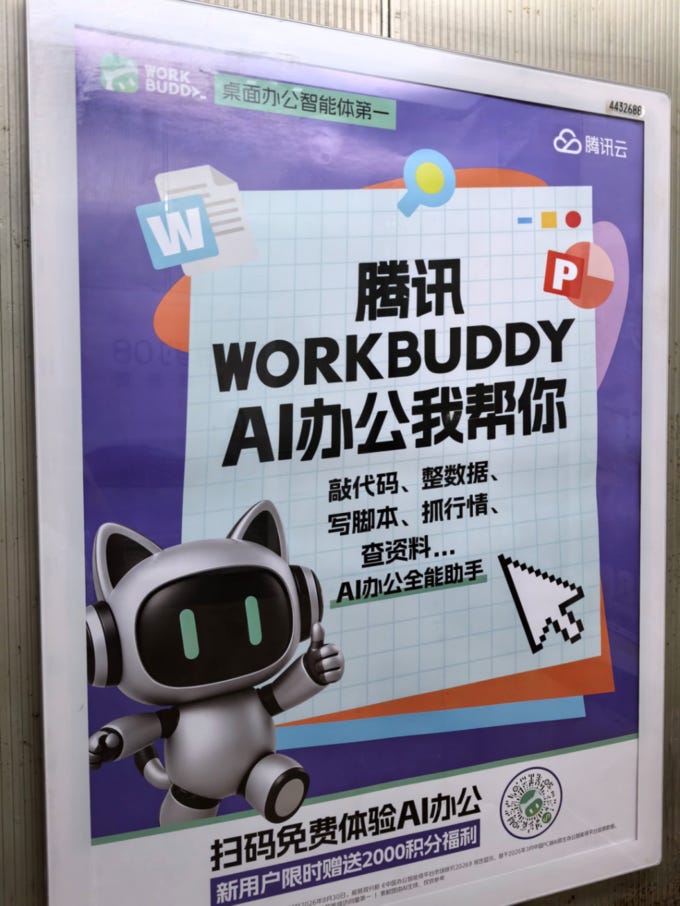
And the usage numbers are impressive: WorkBuddy reached 21 million PC visits in June, more than the next two combined—ByteDance’s Trae and Alibaba’s QoderWork.
This is quite a turnaround for Tencent. A year ago, it was generally seen as lagging China’s AI leaders, with Hunyuan’s performance behind Alibaba’s Qwen and ByteDance’s Doubao. But Tencent has taken a clever route: rather than trying to win purely at the model layer, it did a great job at the product layer, closer to the end users—China’s tens of millions of office white-collar workers—and may now be leapfrogging its rivals there. WorkBuddy first took off during the “raising lobsters” OpenClaw craze in March, before Tencent increasingly repositioned it as a full-fledged office agent.
Today, WorkBuddy is integrated with products such as Tencent Docs and Tencent’s enterprise knowledge tools, and can handle tasks ranging from research and data analysis to documents, spreadsheets and presentations. Personally, I do not find the product itself especially groundbreaking—it feels broadly similar to Gemini inside Google Workspace, Copilot inside Microsoft Office, or other general-purpose AI work agents. But the important context is that this is China, where most users have had little direct access to those products.
The downside of all these developments on AI front is higher costs. Sales and marketing expenses rose 26% year over year, well ahead of the 11% revenue growth, partly due to heavier promotion of games and new AI products such as WorkBuddy. G&A expenses also increased 22%, reflecting higher R&D spending on model upgrades, AI deployment across WeChat and other initiatives.
The bigger number, however, was CapEx. Tencent spent RMB52.7 billion in the quarter, up 176% year over year, pushing reported free cash flow to negative RMB13.8 billion. Excluding prepayments for compute procurement, FCF would still have been a healthy RMB37.6 billion.
The market clearly does not love this level of spending (although last year she also hated when Tencent lagged on AI investment). You can see the concern throughout the earnings call: analysts’ questions ultimately came back to AI CapEx, inference costs and whether all this investment will generate an adequate return.
No one really knows how AI will ultimately play out, what the competitive landscape will look like, how these products will be monetized, or even whether they will earn attractive returns. For now, all of that remains an open question.
Management seems to be sending a reassuring message: if AI does not work out, Tencent can simply cut back the spending, while the GPUs it has already bought can potentially be rented out, redeployed, or even sold. In other words, they seem to view the downside as relatively limited.
Some long-term Tencent investors seem to look at the valuation in a similar way. Using 2025 as a reference, Tencent’s core business should be capable of generating at least ~RMB200 billion of annual FCF before the impact of its AI investments. Striping out roughly RMB1 trillion of net cash and equity investments, the core business trades at less than 15x EV/FCF, which looks pretty cheap for a business of Tencent’s quality.
However, I am a little skeptical of this way of looking at Tencent. Even if the new AI business were succesful, most likely it will fundamentally changes Tencent’s business model. Traditional internet companies such as Tencent were genuinely asset-light. Once the platform was built, growth required very little incremental CapEx. AI is different. It requires continuous spending on GPUs, data centers and inference capacity.
What if AI turns into another prolonged competitive war, much like China’s food-delivery battle, where everyone keeps spending because no one can afford to fall behind? In that case, elevated CapEx could last for years.
I am not saying Tencent’s management is making a mistake, or that they are not excellent operators. In Tencent’s position, they have to invest heavily in AI. But as investors, our job is not to sympathize with management, nor to cling to some old impression of a business (even a great one). It is to assess the risks objectively.
Looking Beneath Moutai’s Profit Decline
On August 14, Kweichow Moutai released its first-half 2026 results. Revenue reached RMB 92.3 billion, up just 1.3% year over year, while net profit fell 1.95% to RMB 44.5 billion. This was Moutai’s first year-over-year decline in first-half profit in a decade, naturally triggering plenty of pessimism among investors.
But we get a clearer picture by breaking the numbers down by product. Revenue from Moutai liquor, the company’s core product, still grew 2.8% year over year, while series liquor revenue fell 6.0%. In other words, even in what is clearly a downcycle for the baijiu industry, Moutai’s core product has held up reasonably well relative to its peers.
Moutai continued to push its consumer-oriented channel reform. Direct-sales revenue grew 29.9% year over year, with revenue from iMoutai jumping 274.2%, while wholesale revenue fell 21.6%. By my rough estimate, moving a bottle from wholesale to direct sales increases the revenue Moutai recognizes by roughly 20% per bottle. Given the scale of the channel shift, that alone should have added roughly 6% to revenue. Yet Moutai-liquor sales grew only 2.8%.
I think part of the reason is that the average selling price within the Moutai-liquor mix has come down. To make Moutai accessible to a broader group of consumers, iMoutai sold more standard Feitian Moutai, while the company capped prices and limited supply of some higher-priced non-standard products, including premium and zodiac editions. The roughly 1.5 percentage-point decline in Moutai-liquor gross margin is, I think, further evidence of this shift, and it also contributed to the decline in net profit.
Overall, I don’t think this half-year report was as bad as the headline numbers made it look. I have seen several arguments that Moutai is still expensive at around 20x earnings, which I disagree.
First, some investors compare today with the bottom of the previous baijiu cycle. Moutai traded at close to 10x earnings in 2013, so 20x today still looks expensive. But I don’t think this is an apples-to-apples comparison. China’s 10-year government bond yield reached nearly 4.7% in 2013, versus only around 1.7% today. Once we adjust for the much lower risk-free rate, Moutai’s valuation today is actually quite close to its historical trough.
Second, one might argue that plenty of high-quality HK-listed internet and TMT companies trade below 15x earnings, so why pay 20x for Moutai? But A-shares and Hong Kong stocks have historically traded in different valuation regimes. Capital controls and the segmentation between onshore and offshore investors have long contributed to higher multiples in the A-share market, so I don’t think this is a completely fair comparison either.
Finally, some may still argue that there are much cheaper companies even within A-shares. Major home-appliance makers such as Midea and Haier trade at 10–15x PE. That is true, but the quality of the businesses is simply very different. Moutai has a gross margin of around 90%, versus less than 30% for major appliance makers.
Bohai’s First 100-Bcm Gas Field
On August 9, CNOOC (883.HK) announced that Phase I of the Bozhong 19-6 condensate gas field had reached full production, with daily output exceeding 5,200 tonnes of oil equivalent, including around 3.5 million cubic meters of natural gas. Meanwhile, Phase II is already under development and is broadly similar in scale to Phase I.

Bozhong 19-6 has particular strategic value as the largest offshore gas field in eastern China. China’s natural-gas resources have historically been concentrated in the west, while much of the country’s demand is in the east. Located close to Beijing, Tianjin and the broader Bohai Rim, Bozhong 19-6 can therefore provide a more stable local gas supply to one of China’s largest population and industrial centers.
For readers unfamiliar with China National Offshore Oil Corporation(CNOOC), it is China’s largest offshore oil and gas producer. Its position is difficult to replicate: its state-owned parent has the exclusive right to partner with foreign companies in offshore China, giving CNOOC a privileged position in developing the country’s offshore resources.
Unlike China’s other large state-owned oil companies, such as PetroChina, CNOOC still enjoys a relatively long runway for production growth. China’s offshore oil resources are estimated to be only around 23% explored/proved, while offshore natural gas is closer to 7%. The opportunity, however, requires increasingly shifting deeper rather than simply coming from untouched shallow-water fields.
That is why projects such as Bozhong 19-6 matter. The reservoirs are buried more than 5,000 meters below the seabed, with temperatures reaching as high as 204°C and unusually hard and complex formations. CNOOC says it developed several new drilling and reservoir-management techniques to make large-scale development possible, including a gas-reinjection approach that helps maintain reservoir pressure.
Essentially, CNOOC is learning how to economically develop reservoirs that are deeper, hotter, higher-pressure and geologically more difficult—potentially opening up another layer of resources that was previously much harder to exploit.
Shan Weijian’s View on China
This week I watched a podcast interview with Weijian Shan, a legendary figure in private equity who is sometimes called China’s “private equity king.” Today, he serves as executive chairman of PAG, one of Asia’s largest alternative investment firms, with more than $55 billion in AUM. He also sits on the board of Alibaba.
Shan’s own life story is just as remarkable. He grew up during the Cultural Revolution, spent six years in the Gobi Desert, then went on to study economics at UC Berkeley under Janet Yellen before eventually becoming a professor at Wharton.

The interview was partly a promotion for the Chinese edition of Shan’s third book, Money Machine: A Trailblazing American Venture in China. His first book was about his life during the Cultural Revolution; his second told the story of how he led the negotiations to acquire Korea First Bank after the Asian Financial Crisis. (I am reading this one now, and I honestly cannot remember the last time I picked up a book and found it this hard to put down.)
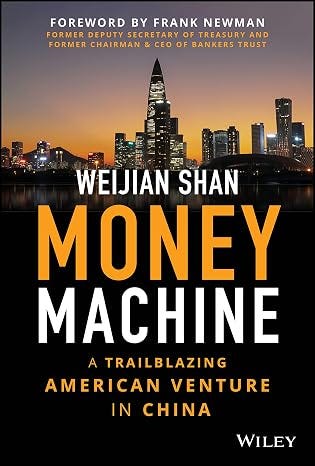
In Money Machine, Shan, the ultimate insider and chief architect of the deal, tells the story of how an American buyout firm pulled off what seemed almost impossible: acquiring control of a deeply troubled Chinese national bank, with a non performing loan ratio above 20%, and turning it into one of the country’s healthiest and most profitable financial institutions. The investment reportedly returned more than 10x in five years.
runs for about an hour and a half, so I will just share one point that I found particularly insightful and agree with: why Shan is not pessimistic about the Chinese economy.
China still has enormous room for both monetary and fiscal policy. On the monetary side, China’s reserve requirement ratio, the share of deposits banks must keep at the central bank, is still around 6.5%, compared with roughly 0% in the U.S., 0.8% in Japan and 1% in Europe. Every one percentage point cut could release roughly RMB2 trillion into the banking system. There is still plenty of room to ease.
The Chinese government has an unusual strong balance sheet. The state owns enormous amounts of assets, and Shan argues that once these are counted, the government is in a net asset position, something rarely seen among major economies, except perhaps Russia. That gives China considerable fiscal capacity. His conclusion is simple: if the Chinese government sets a growth target and is determined to reach it, it has the policy tools to do so.
Chinese households have plenty of money to spend. Household bank deposits now total roughly RMB160 trillion, more than China’s annual GDP of around RMB140 trillion. To Shan, this suggests that the purchasing power has not disappeared; people have simply chosen to save rather than spend, despite very low deposit rates. If confidence returns and even 5% of those deposits flows back into consumption, that would be equivalent to roughly 5% of GDP.
After making his argument, Shan told a little joke, which I will use to end this Weekly Letter:
A shoe company sent a salesman to an island. He came back discouraged: “There’s no market—nobody there wears shoes.” So they sent another salesman to take a second look. He came back thrilled: “The opportunity is enormous—nobody there wears shoes.”
That’s all for now. See you next time.