

H World and Local Governments Put Idle Properties to Work
In September, H World signed a strategic cooperation agreement with the Chengdu State-owned Assets Supervision and Administration Commission (SASAC). The two sides will work together on revitalizing existing state-owned assets, hotel management and asset securitization. Over the next three to five years, H World aims to develop 100–150 hotels in Chengdu, with total investment exceeding RMB6 billion.
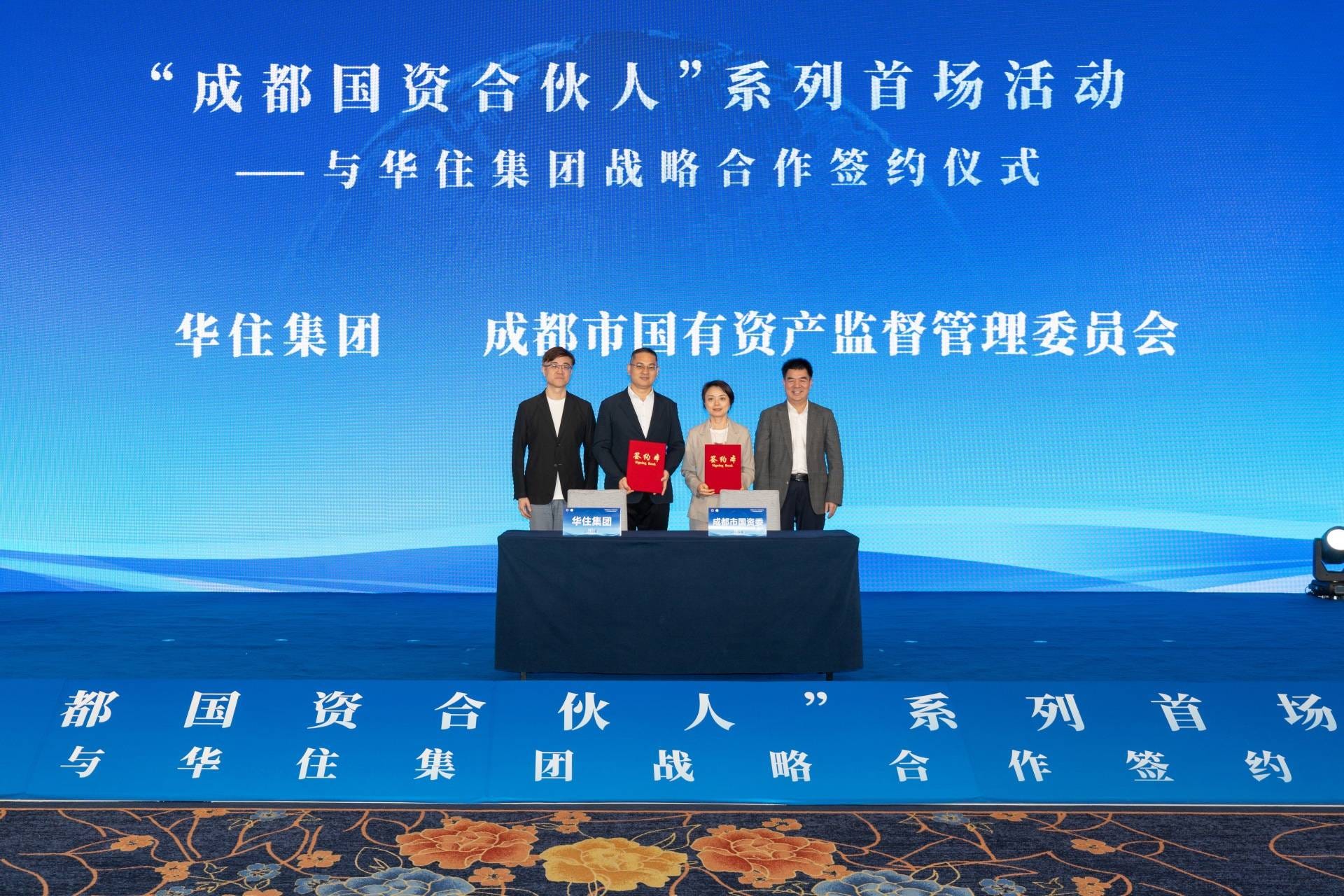
This is not the first such deal. In May, H World signed a very similar agreement with Guangzhou SASAC, targeting around 300 hotels over three years with roughly RMB10 billion of total investment. Guangzhou explicitly framed the partnership around activating existing state-owned properties, hotel management and asset securitization.
The logic makes sense. Local governments and SOEs own a large amount of underused property: office buildings, commercial space and other assets that may generate little return. H World can bring its brands, membership system, supply chain, technology and operating expertise to convert some of these properties into hotels. The headline investment figures also should not be read as H World’s own capex commitments. The Chengdu agreement says H World will bring in both its own and outside investor capital, suggesting the model is designed to remain relatively asset-light.
The final piece is the exit. Once a property has been renovated and the hotel reaches a stable level of cash flow, it can potentially be sold into a REIT, allowing the original owner or investors to turn an illiquid property back into cash. This fits directly with national policy. China moved infrastructure REITs from a pilot program to regular issuance in 2024, explicitly positioning them as a tool to revitalize existing assets and recycle capital into new investment.
I think this is potentially quite positive for H World. It gives the company another source of hotel supply without requiring it to buy the underlying real estate. If the model works, the cycle is straightforward: an SOE contributes an underused property, H World helps convert and operate it, the property is eventually securitized, and H World continues earning management or franchise fees.
China Subsidizes First-Home Mortgages, Property Stocks Swing Wildly
On September 29, the Ministry of Finance, the People’s Bank of China and the National Financial Regulatory Administration jointly announced a new mortgage interest subsidy, effective from October 1. Eligible households can receive a 1 percentage point annual interest subsidy for up to five years, on mortgages of up to RMB1 million. The policy is limited to newly issued commercial mortgages for first-home purchases; the property must be no larger than 120 square meters and cost no more than RMB1.5 million.
At current first-home mortgage rates, a 1 percentage point subsidy is roughly equivalent to cutting the borrower’s interest burden by about one-third. For a RMB1 million mortgage, the cumulative saving can approach RMB50,000 over five years. The policy is clearly targeted at genuine first-time buyers rather than investors—particularly new urban residents, recent graduates and ordinary salaried households—and is another attempt to support housing demand by directly lowering the cost of buying a home.
The market continues to behave in an erratic, emotional way, seemingly unsure how to interpret each new property policy. Is the subsidy a positive sign as the government is still trying to stimulate home purchases, or a disappointment because the support is simply too narrowly targeted?
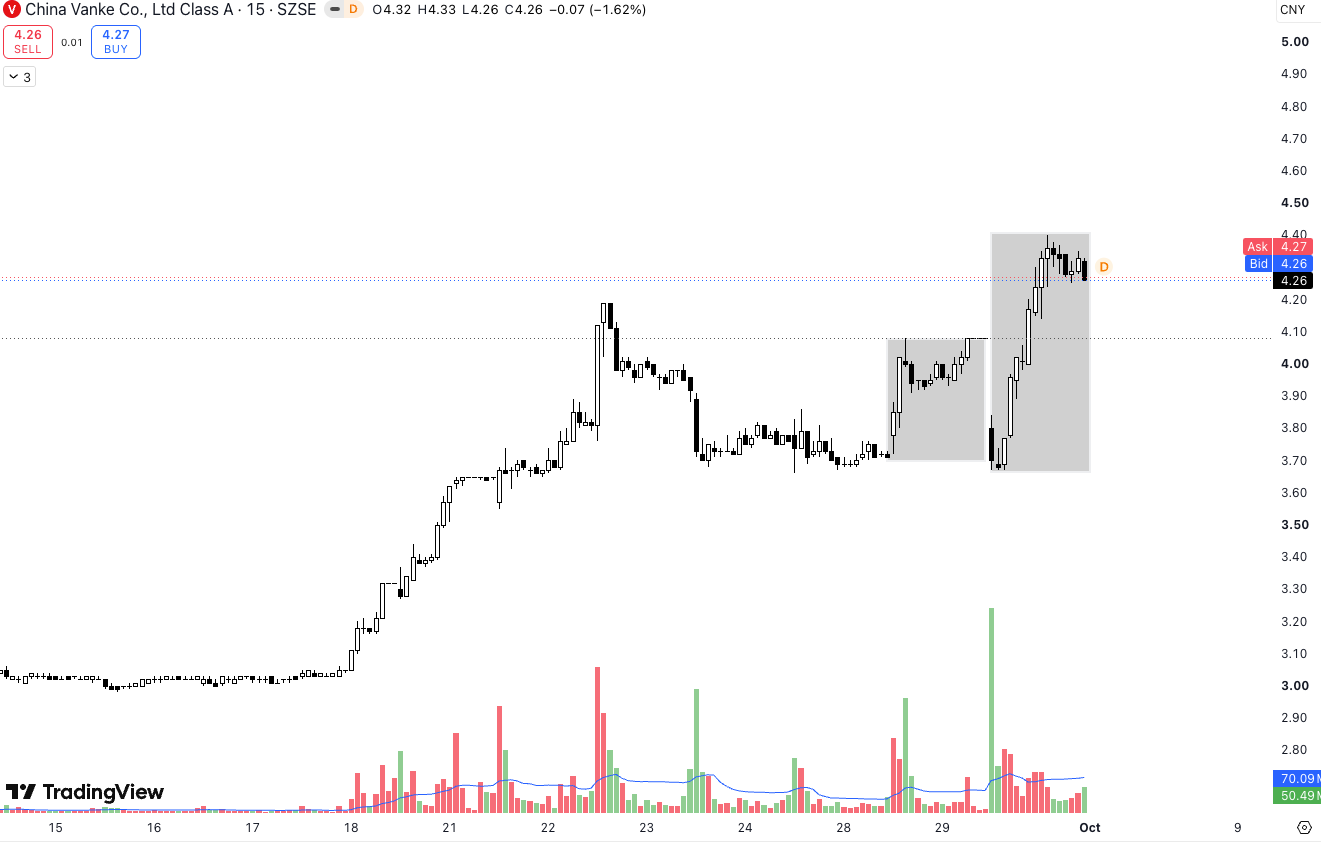
For instance, Vanke (00002.SZ) hit the 10% daily limit on September 29 after the announcement. Next morning, Vanke reversed sharply and touched the 10% downside limit at RMB3.67. Then sentiment flipped again. The stock rebounded to as high as RMB4.40 and eventually closed at RMB4.26, up 4.4% for the day. From the intraday low to high, Vanke moved almost 20% in a single session.
Zhang Kun Steps Down from E Fund Quality Enterprise
One of China's best-known fund managers, Zhang Kun, stepped down this week from E Fund Quality Enterprise Three-Year Holding, a mutual fund he launched in 2020. On its own, the move is not particularly important. The fund had shrunk to just RMB1.5 billion by June, less than 5% of Zhang's remaining assets under management. His flagship, E Fund Blue Chip Selected, still manages more than RMB20 billion and remains under his name.
What is more interesting is the direction of recent developments. Zhang became a fund manager in 2012 and built one of the strongest track records in China's mutual-fund industry. After spectacular returns in 2019 and 2020, money poured in. Blue Chip Selected returned 55.1% in 2019 and 95.1% in 2020, helped in large part by Zhang's heavy exposure to liquor stocks such as Kweichow Moutai, Wuliangye and Luzhou Laojiao. By the end of 2020, those three alone had become a major part of the portfolio.
His AUM peaked at RMB134.5 billion in mid-2021, making him China's first RMB100 billion active-equity fund manager. Blue Chip Selected alone reached almost RMB90 billion.
The timing proved painful. Chinese consumer and internet stocks entered a prolonged bear market shortly afterwards, and Zhang's assets have since fallen by roughly three quarters to RMB32 billion by June this year. In 2025, he also gave up his vice-president-level management position at E Fund, officially to “focus on investment management.”
Then came a more interesting change. In May, E Fund added two co-managers to Blue Chip Selected, the first time Zhang had shared responsibility for his flagship in nearly eight years. A month later, co-managers were added to another two of his four funds. By the end of June, Zhang was the sole manager of only Asia Selected.
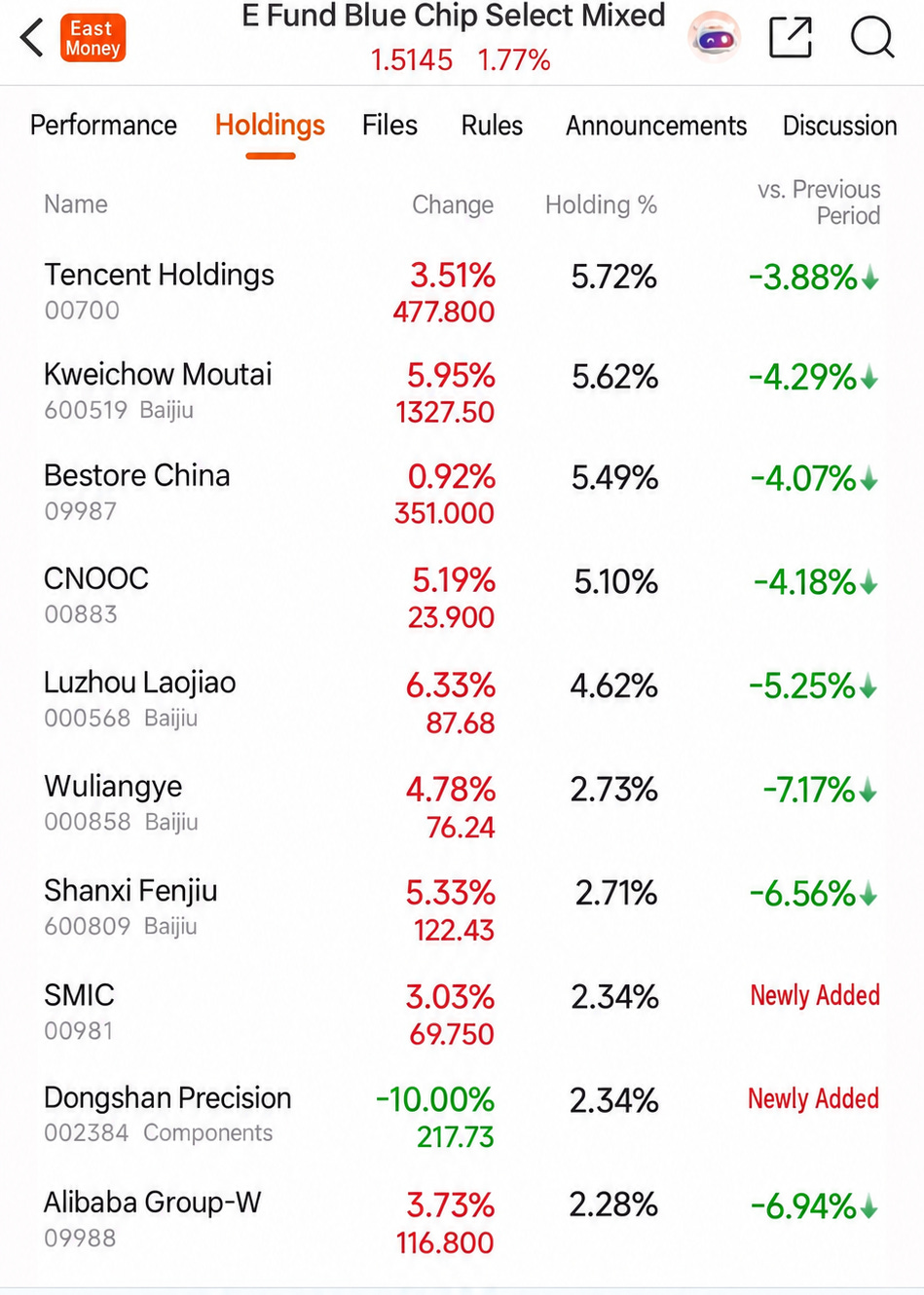
Blue Chip Selected also went through an unusually large portfolio reshuffle after the co-managers arrived. In Q2, its equity exposure fell from 93% to 75%, while its Hong Kong allocation dropped from 46% to 25%. Long-time holdings such as Kweichow Moutai and Tencent were cut sharply, while SMIC and Dongshan Precision entered the top ten for the first time. The fund also reduced its exposure to consumer, internet and healthcare stocks while adding electronics, communications and other AI-related areas.
Now, just three months later, Zhang has completely handed one of those co-managed funds to its new manager. Taken together, the sequence increasingly looks like succession planning rather than simple workload reduction. The real signal to watch is Blue Chip Selected. If Zhang eventually hands over his flagship as well, that would mark the end of an era.
That’s all for now. See you next time.